 In development2026
Pativo
A pet health companion that learns each pet’s normal and states its own uncertainty.
- Project
- Our own product
- Our role
- Product · Mobile development · Backend · AI integration
- Duration
- In development
01 / Behind the product
How we built Pativo
Challenge
AI pet-health apps answer confidently from a photograph and a sentence, and the veterinary profession is pushing back for good reason. An owner can trust that confident tone and delay a vet visit. A one-shot symptom check is also a commodity; what makes the product valuable is the record that compounds and knowing what is normal for that animal.
Approach
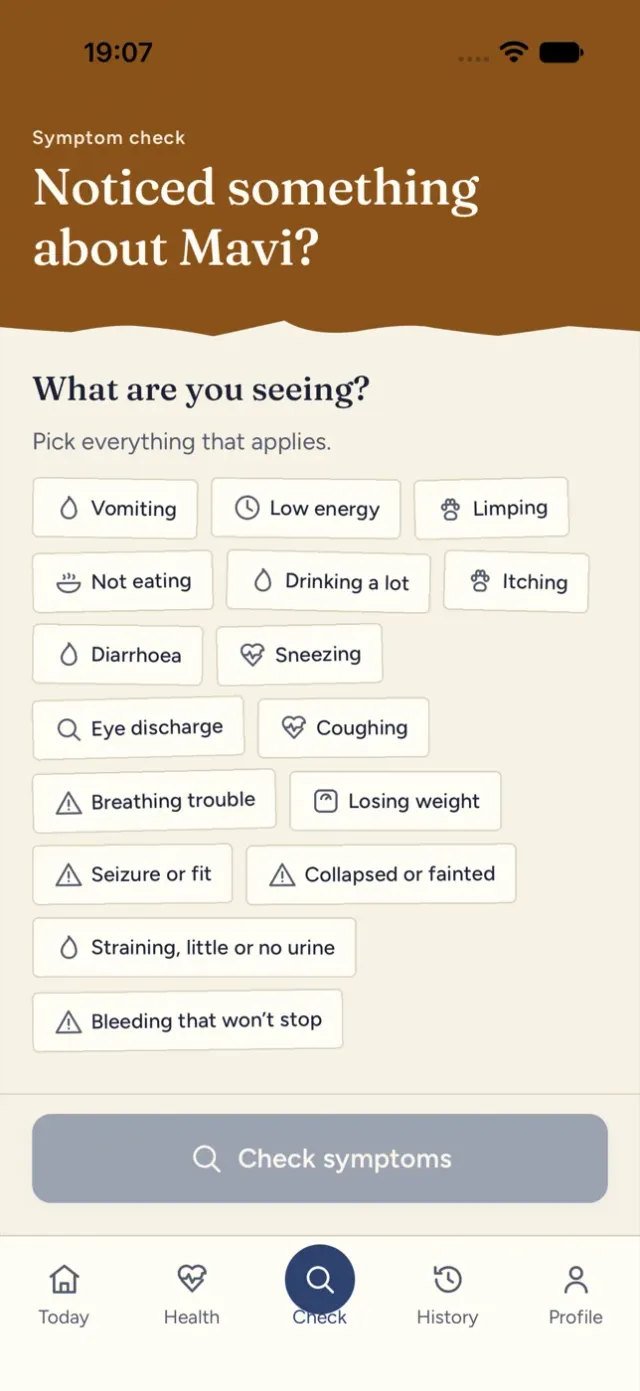
The analysis contract has no field for a percentage. Causes carry a three-step likelihood band and a rationale, every result states what limited its confidence, and a result is allowed to be about the photograph rather than the pet. After the model answers, a deterministic rule floor runs and can only raise urgency: a male cat that cannot urinate, a dog with a bloated belly that retches without vomiting, a cat that ate a lily come out as emergencies whatever the model said.
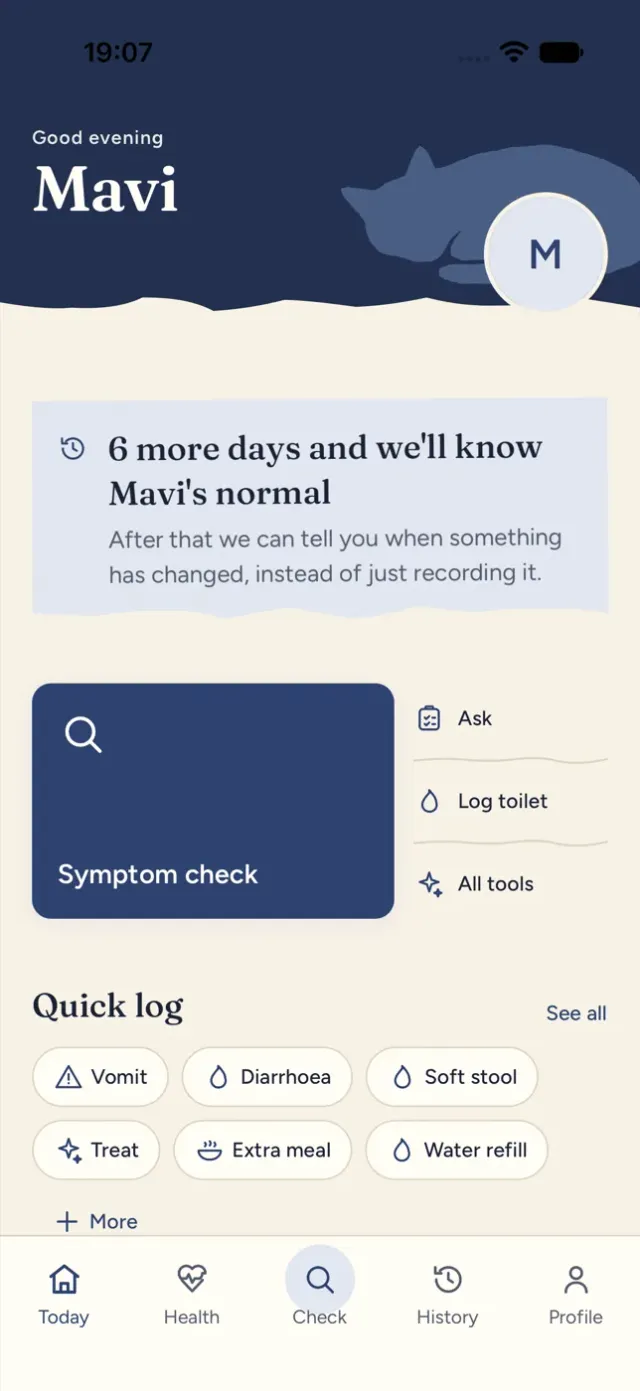
The baseline engine learns each animal’s normal range from a ten-second daily check-in (appetite, energy, water, stool) over a 14-day window and reports a sustained drift once. The model is called only from Edge Functions on the server; when analysis is unavailable the app says so instead of inventing a result. The record on the device is stored encrypted, and photos are downscaled with their location data stripped.
Result
The app started in August 2026 as Pawmo, was reworked from the ground up in November 2026 and renamed Pativo. Two languages became eight; alongside the symptom check and health record came a normal-state album, a photo poison check, a pain score, heat risk, lost-pet mode, a portion calculator and co-owner sharing. The emergency guide works offline and safety features are never paid. Version 1.0.0 is on TestFlight for iPhone; it has not been released on the store yet.
02 / Inside the product
Pativo screenshots
Open a screen to explore the details.03 images
03 / Scope & details
Pativo key features
- 01
A baseline that learns each animal’s own normal from a ten-second daily check-in
- 02
A three-step likelihood band and a rationale instead of a percentage
- 03
A rule floor that runs after the model and can only raise urgency
- 04
Ten species, from dogs and cats to birds, rabbits and reptiles
- 05
Eight languages, with safety phrases kept in a lexicon per language
Technology
INSIDE THE PRODUCT
The engineering behind Pativo
Systems we built and concrete problems we addressed in this project.
No percentage, a band instead
In the src/types/analysis.ts contract likelihood is a three-step band rather than a percentage; every cause carries a rationale and every result states what limited its confidence. The model is called only from Edge Functions, with a strict JSON schema.
A rule floor that can only raise urgency
supabase/functions/_shared/triage.ts runs after the model and returns reason codes. Safety phrases live in a separate lexicon for each of the eight languages, and CI fails when the generated file is stale.
The baseline engine
src/services/baseline/ derives each animal’s normal range from one sample per day, a 14-day window and at least seven entries. A drift run is keyed by the day it began, so the same drift is never notified twice.
"Nothing hardcoded", enforced by lint
Four local rules (no-emoji, no-raw-color, no-hardcoded-text, no-faint-text) are left to the build rather than review; process.env is readable only inside src/config/env.ts.
Your idea could be next.
What could we build for you?
From a first release to a growing platform. Let’s plan the design, development and launch together.
From Türkiye to the US, UK, Australia and everywhere in between.