Game development
Tilting Jar: why reproducible levels matter
Content variety and the ability to reproduce a bug belong in the same game design.
Teach the rules first
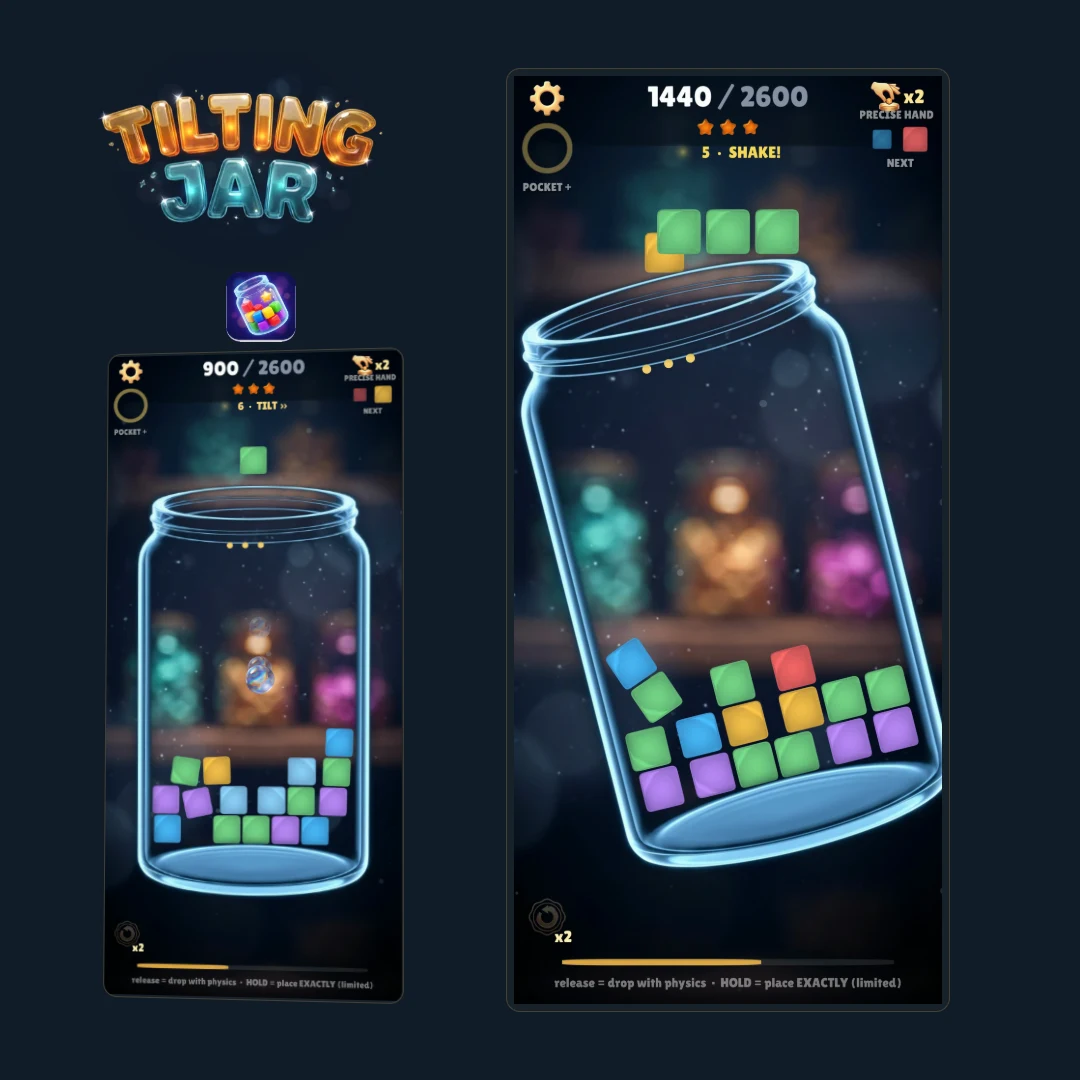
Tilting Jar is our Unity mobile game about placing pieces in a jar whose movements affect play. Announced movements give the player time to prepare. In introductory levels, when a rule is introduced matters more than the amount of random content. Handcrafted teaching and later generated levels therefore have different responsibilities.
Return to the same level index
In Tilting Jar, reproducing content from a level index helps investigate a reported issue. If every attempt produced a different level, separating content problems from physics behavior would be harder. Repeatable content gives us consistent inputs for comparison. This does not claim bit-for-bit identical physics across devices: content generation and runtime simulation are separate concerns.
Define generation rules that can be checked
A level generator needs explicit rules for valid pieces, introduced mechanics and progression boundaries. Changes also need to be considered against earlier levels. Game feel is evaluated by playing on devices, while generated content can be checked against its own rules. When scoping a prototype, we plan how to return to a reported problem alongside how the controls should feel.
Level identity should be separate from the daily challenge
Tilting Jar begins with 24 handcrafted levels; its current catalog presents 300 levels in chapters of 20. Later levels derive their generation seed from the level index. The daily jar loads a separate definition instead of behaving like an ordinary level index. This keeps the daily challenge outside normal unlock and progression calculations. Reproducing starting conditions does not imply that every movement in the physics simulation will be identical.
APPLY IT TO YOUR PRODUCT
Game Development
Hyper and hybrid casual mobile games with Unity 6. Level generation, economy, LiveOps and store process included.