 In development2026
Screwsmith
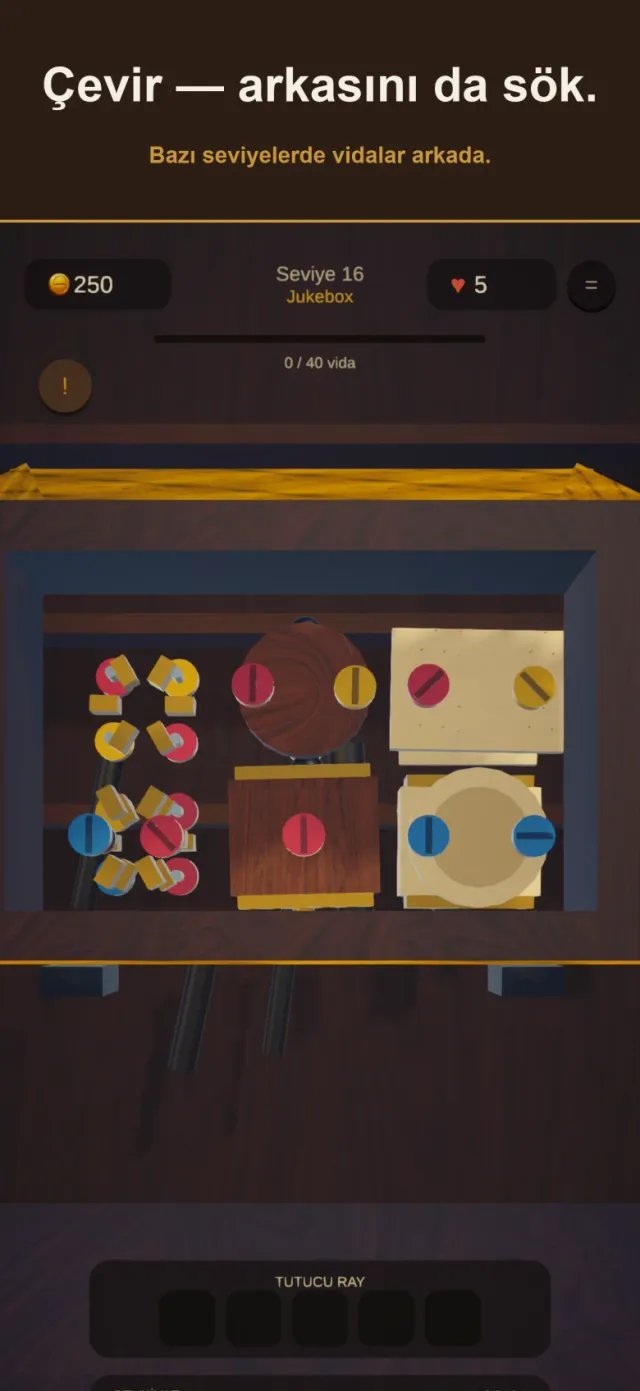
Remove screws, sort colors and uncover the layers of each machine.

- Project
- Our own product
- Our role
- Design · Software development
- Platforms
- iOS
01 / Behind the product
A real need. A considered solution.
Challenge
In a screw-removal puzzle every move changes the layer beneath and the room left on the holding rail; the real question is not which screw, but in which order. Producing 200 levels in two weeks and making sure they are both solvable and correctly difficult is not something one person can do by hand. And difficulty measured against perfect play is misleading: almost every level survives perfect play.
Approach
The rules engine (GameSim) is deterministic, engine-free and fully replayable, so the solver evaluates a level without opening a scene. The solver produces two numbers: the minimum rail slots needed under perfect play, and how often a plausible human loses the level. The difficulty curve is tuned against the second.
Levels are baked at build time: generating candidates until one lands in the requested band costs over a second per level, and that cost is paid by the build rather than the player. A readability audit catches pixel facts before any play test: a touch target of at least 8.5% of screen width (about 4.7 mm), colour-blind pairs, screws under the HUD. An undo audit compares the board before a move and after undoing it on every level, and proves it can fail via a sabotage flag.
Result
200 baked levels, 16 machines, five tools, a five-slot rail. The difficulty curve is deliberate: the first 35 levels are gentle, 36 is a wall, then a three-easy / two-hard rhythm. The Daily Bench is seeded from the date and needs no server or account; everyone gets the same machine. Turkish and English store copy is written to Apple’s character limits. The privacy and support page for 1.0 is live; development continues.
02 / Inside the product
The experience, on screen.
Open a screen to explore the details.04 images
03 / Scope & details
The details make the experience.
- 01
200 baked levels, 16 machines, five tools
- 02
Engine-free deterministic rules engine; the solver measures without opening a scene
- 03
Difficulty curve tuned against human loss rate
- 04
Readability and undo audits
- 05
Date-seeded Daily Bench, offline play
Technology
INSIDE THE PRODUCT
The engineering behind the interface.
Systems we built and concrete problems we addressed in this project.
The solver produces two numbers
Minimum rail slots measures perfect play: 2 is a warm-up, 5 leaves no margin. But almost every level survives perfect play, so the curve is tuned against how often a plausible human who cannot see the crate queue three moves ahead loses; worst rail occupancy is recorded as a trial average too.
The undo audit proves it can fail
Undo once restored crates by position and deleted the wrong crate when a crate pulled during a move was filled and sealed on a later pass of the same move; nothing noticed because nothing compared the board with its pre-move state. The audit now makes that comparison on every level and validates itself against a broken sim through a sabotage flag.
The measurable half of the readability gate
Apple and Google both land on ~9 mm; for a round screw among neighbours the contract is 8.5% of screen width (~4.7 mm), the floor below which mis-taps rise sharply in the touch literature. Colour-blind pairs and screws under the HUD are caught in the same loop and never reach a play test.
Your idea could be next.
What could we build for you?
From a first release to a growing platform. Let’s plan the design, development and launch together.
From Türkiye to the US, UK, Australia and everywhere in between.