 Our own product2026
AKSVERO
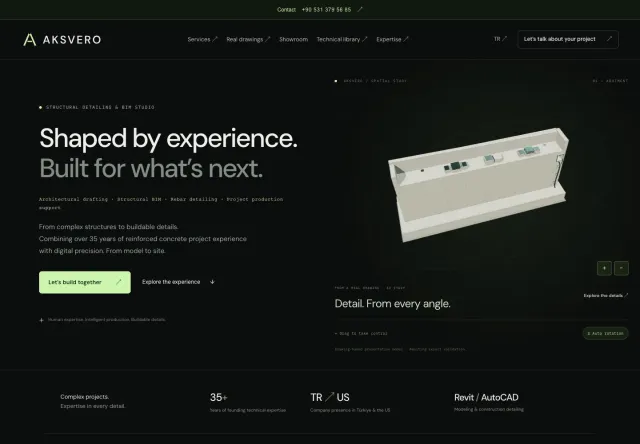
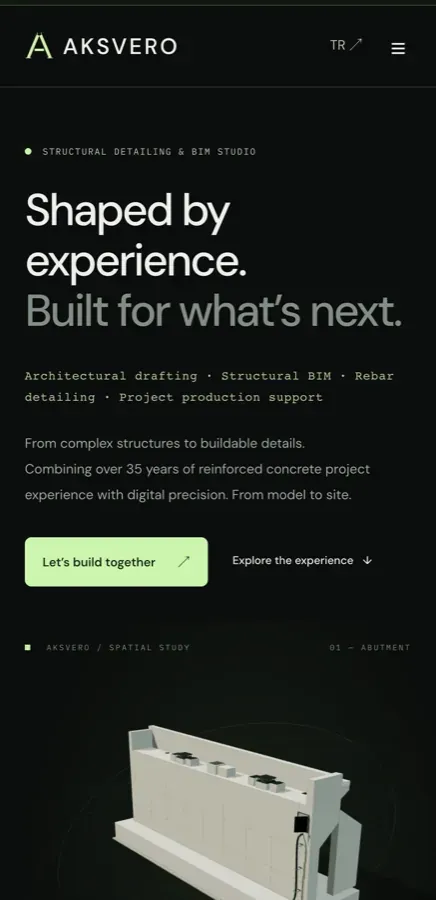
The website of a structural detailing and BIM studio, and the rebar engineering tool behind it.
- Project
- Our own product
- Our role
- Co-founder · Website · 3D · Engineering tool · Cloudflare architecture
- Platforms
- Web
01 / Behind the product
How we built AKSVERO
Challenge
AKSVERO is a studio for reinforced concrete detailing and BIM production that pairs its founding technical specialist’s 35-plus years of reinforced concrete project experience with software. That work is hard to explain on a website, because the work is the drawing and the detail; stock photography cannot show it. The slow part of the job is the rebar itself: modelling bars one by one, checking them against the code, producing quantities and sheets.
Approach
The site opens with a three.js model built from a real bridge abutment drawing; visitors orbit it and move on to real drawing sheets and technical review cases. It is in Turkish and English and runs on Cloudflare Workers; inquiry forms are written to D1, and a scheduled job retries when the email does not go out.
Behind the site is a sign-in-only engineering tool the studio uses itself. Rebar is generated by parameter from 14 structure templates (pier, footing, abutment, retaining wall, box section, tunnel and others) and edited in 3D. The rule engine runs 89 rules from sources such as TS 500 and the bridge specifications, each citing its clause; formulas are evaluated in a whitelisted expression language with no eval.
We wrote the IFC reader and writer ourselves: a model from Revit comes in, and the result goes out as IFC4, DXF sheets and a bar schedule with quantities. An AI task agent carries out design tasks, and a second, independent run reviews the work seeing only the request and the result.
Result
The site is live at aksvero.com in Turkish and English. The engineering tool is used inside the studio; according to the verification report in the repository its analysis core passes 178 sourced benchmark cases. Some rule values still await expert verification, and the 3D model on the site is a presentation model, not a certified project model.
02 / Inside the product
AKSVERO screenshots
Open a screen to explore the details.03 images
03 / Scope & details
AKSVERO key features
- 01
A 3D model built from a real abutment drawing that visitors can orbit in the browser
- 02
Rebar generated from 14 structure templates by parameter and edited in 3D
- 03
A checking engine of 89 rules, each citing its clause
- 04
Our own IFC reader and writer: Revit models in, IFC4 out
- 05
DXF sheets, bar schedules with quantities, and a delivery package
Technology
three.js / Vite / React / Hono / Cloudflare Workers / Workflows / D1 / R2 / Drizzle
INSIDE THE PRODUCT
The engineering behind AKSVERO
Systems we built and concrete problems we addressed in this project.
A rule engine that cites its clauses
There are 89 rules across ten YAML files under engine/rules/, each carrying its source and clause. Formulas are evaluated in the whitelisted expression language in shared/rebar/expr.ts, with no eval.
A dependency-free IFC reader and writer
shared/ifc/step.ts parses the STEP file inside a Web Worker; bars are read from swept-disk centrelines because Revit’s IFC4 export leaves the bar type data empty. shared/design/ifc.ts writes one IfcReinforcingBar per rebar set.
Large files and access
Files up to 5 GB upload to R2 in 16 MB parts and resume after a reload. Download links are five-minute signed URLs, and a request without a session sees the site’s 404 page.
Your idea could be next.
What could we build for you?
From a first release to a growing platform. Let’s plan the design, development and launch together.
From Türkiye to the US, UK, Australia and everywhere in between.